Tim Bryant’s recently released novel, The Bird in Your Heart, is a beautifully conceived and tightly woven chronicle of the geography, traditions, and superstitions of the South Carolina Lowcountry; generational expectations; family; friendship; racial barriers and bridges; good whiskey; the persistent lure of sailing across the open sea; and the therapeutic value of bird watching. If you’re thinking that’s a lot, you’re right, but that ain’t all. Included also are a mysteriously missing father, divorce, wedding, Gullah mysticisms, a sweet-running Jaguar automobile, a battered Land Rover, spoiled rich people, a beautiful sailboat, an epic storm, an explosion and fire, and a just-right dose of romantic love. One may ask how Bryant pulls it all off. I’m not sure, but I suspect Lowcountry magic . . . or there’s the more likely explanation that his success is due to masterful craftsmanship.
The art of weaving together various plot points, scenes, and characters requires talent and an overriding desire to get things right. Because Tim Bryant possesses these traits in abundance, the reader glides easily through the chapters, eager to see what happens next, even though the novel doesn’t rely on cheap suspense and cliffhangers. It’s all in the balance: Bryant in this regard matches the best of the plate-spinning, sword juggling, unicycle riders of the literary world. Jane Smiley, Jodi Picoult, and Richard Russo come to mind. I’m sure you can think of your own favorite authors who can explore several narrative arcs in the same novel without the book becoming too plot heavy.
Plate spinning and juggling require a solid foundation on which to distribute the weight. This is where careful scene construction comes into play. Consider this description of an Edisto Island landmark, Rupert Wright’s bait shop:
. . . I could see him as he always was: on the porch of his bait shop . . . rocking in his chair, looking to be asleep, but not. He was as black and hard as coal and his hair was like the white ash that appears when coal begins to heat up. I always thought of him as the oldest person alive because his appearance made it seem so. Yet . . . he never seemed to age further. . . . Visiting Rupert’s store was a fork in the road decision, with consequences large and small. . . . You had to willingly surrender the reassurances of good, county-ordained pavement to accept the consequences of loose gravel over oyster shells and sand. A right-hand turn then another then another, then a left and another right. Woods . . . mudflats . . . scrublands . . . not much else. At about the time you’re uneasy enough to consider turning back, Rupert’s hand-painted signs appear at intervals along the way, announcing “ICE COLD GRAPE SODA!” “POTTED MEAT!” and “Worms and Crickets Just Ahead!” as if tidings of great joy. Then it hits you that you’re in deep, deeper than you’ll ever know.
Rupert and his disheveled store—replete with fishing gear, canned potted meat, soft drinks, boiled peanuts, yams from the garden, comic books, toilet paper, and most anything else a person in that neck of the woods might need—figures heavily in the novel as a place of insight, point of reference, an avenue for comfort, and sanctuary for clear thinking.
Jack Hamilton, the novel’s protagonist and narrator, has been away from Edisto for a long time. Upon his first trip back to Rupert’s store, he’s filled with waves of nostalgia. He has escaped a bad marriage to a spoiled rich girl and an unsatisfying seven years of serving as a senior executive in her father’s ad agency. Now he’s leaving Atlanta behind, the posh Buckhead apartment and his precarious perch among Atlanta’s elite society. He is ready for a fresh start and finally to embark on his lifelong dream of sailing the open seas.
He arrives back in Edisto, where he grew up, to find that some things have changed while others have not. The birds are still there. In fact the novel opens with a Boat-Tailed Grackle flying high over the island, “above marshlands and swamps, across small struggling farms, and narrow, rough-edged roads disappearing between old oaks. It swooped in low for a closer look at tidy white cottages where clothes hung on lines like dots and dashes . . . and then soared farther out to where the few old plantation homes remained, some freshly painted, others desecrated by the seasons: from airless summer heat to shivery winter drafts and, in between, salty storms blowing in from the sea.”
The grounds and old plantation house where he’d grown up were largely the same, at least to the casual observer, but Jack soon discovered, after an uncharacteristic plea for help from his mother, that the old place was “falling down” around her. The mother’s health, particularly her vision, was also in decline. Jack wasn’t prepared for this. He needed a place for rest and quiet reflection as he envisioned the sailboat he’d buy with the settlement money from the divorce and severance from his father-in-law’s firm. He’d been paid a considerable sum to basically go away, and that’s what he’d planned to do, still planned to do until he received another round of bad news from his mother’s banker: her money was all gone. Now Jack’s dreams were in jeopardy. Would he “man up” and do the right thing, or would his selfish desires get the better of him.
In making choices for his mother and himself, Jack becomes torn and entangled. The realization that the path to freedom will not be found entirely through his own efforts but through the surprising behavior of those he loves—along with some unexpected twists of fate—comes hard. Will the nagging questions of his childhood be resolved? Will his hopes and dreams—at least some of them—be realized? In reading The Bird in Your Heart, you’ll accompany Jack on this rewarding ride through misadventures, false starts, and revelations. Bonuses include learning about Lowcountry life, bird watching, and perhaps a thing or two about yourself.
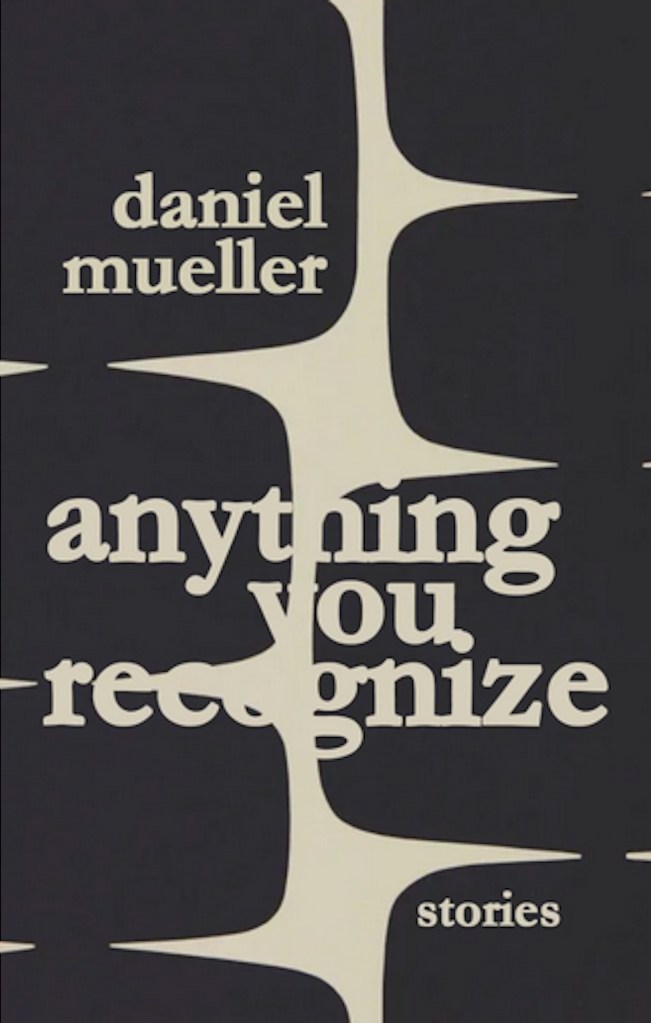
Dan Mueller’s new story collection, Anything You Recognize, works as a precision machine, similar to the core drills geologists use to bore deep into the earth’s crust in order to bring up samples from the various layers and strata. The result is a remarkable cross-section of humanity’s collective psyche. Mueller’s process also involves chopping the samples into distinctive bits and asking the reader, “Anything you recognize?” Or perhaps the book says, “Pick up and take with you anything you recognize. Surely some of these pieces belong to you.”
The collection as a whole feels autobiographical, especially in the authenticity that’s conveyed through the manifold scenes, situations, and conflicts. While the reader may envision Mueller as a boy, young man, and mature adult through the stories, only the author knows where the boundaries lie between autobiography and fiction; in fact, the worlds created here are so precise and familiar that Mueller himself may not know where the murky lines lie between actual and imagined experience. In his mind the scenes conveyed—through the toil of writing them—may have displaced what existed before in his memory, creating masterful fiction in the process.
Many period-correct details contribute: Thingmaker oven with bottles of glow-in-the-dark Plastigoop for making Creepy Crawlers, Country Squire station wagons, the Apollo 11 moon landing, Vietnam War, stereo record players built into heavy wooden consoles, black-and white TVs, Hot Wheels raceways, Rock ’em Sock ’em Robots, and G.I. Joes. These brush strokes are placed within the seven stories that feature a young boy protagonist who, as an adult, recounts events from his fifth through tenth year, a period fraught with challenges largely brought on by his father’s being drafted into the Army to serve as a medical officer.
The family’s subsequent move from Greely, Colorado to Fort Hood, Texas presents the boy with painful realities, confusion, and opportunities for growth. He suffers a feeling of helplessness over the dissolution of a close relationship with a neighborhood boy, resulting in the evaporation of a vow they’d made to be “first, best, and last” friends for life. This story and the others that center around the youngster resonate with the poignancy of his grappling with sexual mysteries, hard-candy lozenges that stick in the throat, the confusing behavior of grown-ups, pangs of childhood love, racism, and the disappointment that comes with discovering how imperfect people are—friends, family, and himself.
He feels guilt over killing a robin with a slingshot, stealing a snapping turtle from a new boy in the neighborhood in order to elevate his own status, and relishing the suffering of others. Growth occurs, though, in these episodes, along with knowledge that life will continue to confound while providing opportunities. The realization, instilled early in the boy, that fulfillment—or happiness—will always be elusive is further explored in the eight offerings in the collection that involve adults in adult situations.
The adult stories—indeed the collection as a whole—utilize the time-honored journey motif. Two of the tales involve a free-spirited couple who travel down the west coast from Alaska to Tulum, Mexico, financing the trip with money saved from a summer spent working in a salmon processing plant in Alaska. Cleverly, they sew their cash savings inside secret pockets within their backpacks. Their “tentative, one-sided love,” as well as their plans to winter in tropical Tulum, are upended by what happens after they rent a “cabana,” really little more than a thatched-roof bamboo hut, the security of which proves to be woefully inadequate. Their journey interrupted, alternate routes will be necessary.
“Nothing Has to Happen,” features a middle-aged would-be writer seeking inspiration along with relief from a troubled marriage and the detritus of his mind. On his trip from New Mexico to Virginia for a writers’ workshop, he envisions peaceful evenings spent at campsites along the interstate, sipping beer by the fire and relaxing under the stars. He hopes that tranquility and introspection will provide the clarity and perspective needed in order to produce some writing worth sharing. The events that transpire, while not providing tranquility, do show him how quickly lives and plans can be altered through one simple act or slip of the tongue. Now, at least, he has something to write about.
“The Embers” presents not a physical journey but one through time in the form of a monologue from an OB-GYN doctor addressing his former pastor, who “had the air of a counselor to whom much had been entrusted.” The monologue chronicles deep connections over many years between the doctor’s family and the pastor’s. The doctor’s violation of his own moral code not once but three times through his admiration for the pastor becomes the connecting thread through this painful trip. In the story’s present, years after the recounted pertinent events, the pastor’s health and memory are in decline. The time for reparation or apology has passed, but the doctor, by revisiting painful memories, has released some of his burden and gained understanding of how their shared journey brought him to where he is now.
The adults in this collection are travel weary, whether their journeys have been physical, emotional, or both, scarred by their struggles along the road of life. While these tales encompass disappointment with spouses, romantic partners, friends, family members, respected counselors, and life in general, they are permeated with the fragrance of love, perseverance, and faith. The stories about the boy mirror these same qualities as the youngster tries to reconcile what he can’t understand or fix in the present with what he hopes for in the future. Like all trips worth taking, Anything You Recognize presents challenges, but spending time in the worlds Mueller creates is ultimately heartening, providing joy gained from an appreciation of characters we recognize as being very much like ourselves and those we encounter during our individual life journeys. The collection will be officially released on September 19, 2023 through Outpost19 Books and is available now for pre-order on the publisher’s website and on Amazon.
Author Daniel Mueller with his daughter Lili, hiking in New Mexico’s Sandia Mountains
An Interview with Daniel Mueller
RY: Many of the stories in your latest collection, Anything You Recognize, feel autobiographical. Don’t worry, I’m not going to ask you what is or isn’t, but rather if you could offer advice to writers who would like to incorporate actual events and characters into their stories but struggle with how to do so. For example, how do we include characters based on family members or close friends, especially if we’re using their foibles or flaws as part of the narrative, without jeopardizing friendships and causing rifts within the family? Also, how much of our own flaws and embarrassments should we be willing to expose in order to bring authenticity and emotional resonance to the tale? In your own writing where do you draw the line?
DM: That’s a great question. Nearly every story I’ve ever written stemmed from something that happened to me in real life, but, you’re right, this collection is more overtly autobiographical than my previous two. Indeed, all but one of the early childhood stories, of which there are seven in the book, were published first in literary magazines as creative nonfiction. For me, the experience of writing fiction and creative nonfiction aren’t all that different from each other; like most writers, I’m always only ever trying to wring the best story I can from material that has in some way captivated me. In fiction, the question for me is, what’s the most interesting thing that could’ve happened but didn’t. In creative nonfiction, the question is, what’s the most interesting way of presenting the thing that did. In truth, whether I’m calling what I’m writing fiction or creative nonfiction, I don’t worry about whether actual people who see likenesses of themselves in the work will be happy or not. I know this probably sounds awful of me, but for as long as I’ve been writing I’ve privileged the story itself above all other factors, believing that if it succeeds, those who in some way figured in it won’t mind how they’re portrayed. And, I also believe, for a story to succeed at all, love must serve as a binding agent, and maybe even more so in dark stories. This said, my sister didn’t talk to me for a year after she read a short story in which her wedding figured as the central action. She’d asked me not to use her wedding, during which the best man died in a drowning accident under suspicious circumstances, but I was there, too, and so the experience was also mine, and the protagonist of that story, loosely based on me and what I was going through at that time, supplied the story’s meaning, at least for me. It’s difficult, I think, to see ourselves clearly in the here and now, and when we put ourselves in stories, hopefully warts and all, it’s almost always a past self that finds representation. In the stories from early childhood mentioned earlier, the fifty + years of temporal distance made it easier to be honest about my own flaws and the cringy things I thought and did, but I also think that readers, whether they know it or not, turn to literature for a degree of honesty and intimacy that’s hard to come by in our day-to-day interactions, and that’s what I try to give readers.
RY: As I was reading these stories, a notion—somewhat foggy as it originated from my sophomore survey courses—took root: that the classic journey motif presents itself throughout this astonishing collection. Most of the stories involve a physical journey. The few that are confined to a single place still imply a journey, albeit emotional or spiritual in nature. This concept seems especially applicable to the ones that feature the young boy, Travis, as the protagonist. Without stretching it too far, these tales combined could qualify as a classic hero’s journey as the youngster struggles against a variety of obstacles, most of which are peculiar to the individual locales he moves through with his family. In Greeley there’s an older boy whose physical development far exceeds Travis’s and his best friend’s, resulting in “smarting palms left by his fastballs, the stinging nipples left by his spirals, the grass-stained abrasions left by his guillotine chokes and Indian deathlocks.” There is also the internal struggle caused by being uprooted and having to move away from his friend David, whom he ultimately betrays by leaving him alone in a compromising situation and at the mercy of Jerry, the sadistic stronger boy. In San Antonio he grapples with trashy, borderline abusive grandparents along with confusing adult language and why his parents don’t seem happy. In the last of the Travis stories, we find our hero in yet another new community, approaching adolescence, grappling with self-image problems and his need for love. Throughout his years-long journey the boy is growing and changing, discovering truths about himself, society, and human nature. Could you shed light on the journey motif concept, whether or not it applies here, and how it did or didn’t figure in the construction of the stories and the collection as a whole?
DM: A point of pride for me is the interconnectedness of the Travis stories that lends an arc to the new collection that my previous collections lacked. I didn’t set out, however, to render a hero’s journey. After my father passed away in 2012, I went through a hard patch emotionally, psychologically, and a year later I started seeing a therapist to address the question of why I felt such paralyzing guilt. She asked me to share a few memories from my early childhood to try to identify the origin of a debilitating self-image I had carried within me for as long as I could remember, and she was surprised when I couldn’t remember much before sixth grade. For eight weekly sessions, she asked me to try to remember specifics from my life when I was much younger, five, six, seven, and eight, but I couldn’t, try as I might. But about a year later, I had a memory from the years when my mother, father, and baby sister lived in Greeley, Colorado, my father fresh out of medical school. You might remember it from “An Incision in the Reeds.” The kid tries to sic the family’s boxer Duchess on a grieving mother walking past his house on her way back from a funeral for a son killed in the Vietnam War. I wrote that vignette, and then the strangest thing happened. Another memory came to me, the one in “Cache la Poudre” about incinerating the paper trash and the slingshot Travis and his friend David pool their allowances together to buy at the Rexall Drug. Long story short, I spent the better part of two years giving narrative form to these little memories that seemed to pop into my head one after another, like saplings connected at the roots. In 2016, University of New Mexico awarded me a sabbatical, and I spent the year organizing the fifty or so vignettes I’d written into stories I then submitted to literary journals as creative nonfiction essays. The other stories in the book were written before or after the Travis stories, and as I was organizing the pieces into the manuscript you read, I was pleased by the coherence achieved inadvertently by alternating between the Travis stories and the other ones. Ultimately, I hope that discerning readers will see the book as a portrait of the artist as a very young boy and a nod to one of the writers I admire more than any other, James Joyce, which is probably wishful thinking on my part.
RY: The prose in this collection is rich with artfully constructed sentences brimming with details presented through, at times, complex grammatical constructions. Writing of this caliber stands in striking contrast to the minimalist styles of contemporary authors such as Raymond Carver, Chuck Palahniuk, Amy Hempel, Brett Easton Ellis, Cormac McCarthy, and many others. Are you intentionally bucking a trend with your long, luxurious sentences that adhere to the standards of formal usage? My suspicion is you grew up in a household where your parents were sticklers for correct grammar. Are you disappointed by current language trends that depart from traditional conventions regarding who/whom, lie/lay, split infinitives, and ending sentences with prepositions? Do you have other grammar-related pet peeves? In drafting your stories how much consideration do you typically give to sentence structure and why does it matter?
DM: Thank you, Ron, for complimenting my style, which has been hard-won. If I could be a minimalist like Raymond Carver, Amy Hempel, and Denis Johnson, I would. By the same token, if I could be a maximalist like William Faulkner, John Cheever, Gabriel Garcia Marquez, and Stanley Elkin, I would. At points in my life, I have tried to be both. My writing style, however, lies somewhere between these two extremes, and I spend hours drafting and redrafting stories on the sentence level to get them to sound like me and, I hope, no one else. There’s also narrative strategy involved in complex sentence structures. A complex sentence demands focus, and if you can elicit a high level of attentiveness from readers, they’ve likely suspended their disbelief in the effort, and the language alone can carry them to strange, often surprising, more nuanced states of consciousness. Ultimately, I want my sentences to sharpen vision, to improve the reader’s capacity to see.
RY: There’s a beautiful paragraph early in “Antivenom” that describes Travis’s maternal grandmother Izzy and her second husband Leo. A textured portrait is presented, in a little over one hundred words, that highlights the couple’s overall tackiness as well as their lifestyle and how others might view them. This is accomplished not just through physical details but also by incorporating phrases such as “in cahoots” and Travis’s dad’s snide summation of them as “a real pair.” Colors also are deftly used with descriptions of photos of the couple in their natural surroundings: “. . . on the front steps between blazing pink azalea bushes in concrete urns . . . she pumpkin-shaped and ethereal, he leather-skinned, silver-buckled, and gritty.” This passage is but one of many throughout the book that do the heavy work of placing three-dimensional people into authentic worlds. Developing characters this way with nuanced bits of information coming from different angles must require, along with imagination, a keen eye for details, robust memory, and cleverly pointed research. Please share something of the process(es) you use to create these memorable portraits.
DM: Every writer comes to their subject matter with certain strengths and weaknesses. I’ve always loved describing things that I can see in my mind’s eye and giving them substance, and when I’m writing and revising (which for me are synonymous), I’m striving for greater and greater exactitude. It’s fun because I’m good at it, or I’ve gotten good at it. I struggle with dialogue, however, with capturing how characters express themselves in speech, and while rendering talk isn’t as fun for me as description, I’m dogged in my commitment to getting it as right, or close to right, as I can. If I’ve improved as a writer of dialogue, it’s from studying writers who excel at it. Antoine Wilson is a writer whose dialogue I loved when we were classmates at the Iowa Writers’ Workshop in 1998. Now when I read his work—his latest novel, Mouth to Mouth, is superb—I pay special attention to how his characters speak, how they differentiate themselves by how they speak, and pray his ear for dialogue will rub off on me. Because I want my stories to be driven by the characters in them, I utilize as many modes of narration as I can, those I’m adept at as well as those I’m clumsier with, to give them the dimensionality of actual people. Great writers are masters of multiple modes of narration, and characterization occurs not only by how the characters interact with one another dramatically, but by how they’re apprehended and remembered by other characters. Izzy and Leo were real characters in real life, and I wanted readers to remember them as I still do, as larger than life when seen through the eyes of a six-year-old boy who has somehow become the sixty-two-year-old narrator.
RY: The natural world figures prominently in several of the stories. In “Nothing Has To Happen” the narrator sets up his tent “in a site shaded by caddo maples and the narrow canyon walls, [where] in the receding daylight the yellow green leaves popped against the orange cliffs.” In “Ground School” a father and daughter negotiate a hiking trail that comprises “a 30-foot sheer rock wall; a grade punishing to the ankles, knees, and hips; a meadow of corn lilies . . . in which for a quarter mile the trail vanished and on each toxic, greenish blossom a hornet rested like the black iridescent knob of a scepter. . . .” These and other passages that also present the outside world as vibrating with life and portent must have been influenced by your own experiences. What role does spending time with nature play in your creative life? I’m sure you are often able to utilize details directly from memory of places you’ve visited, but how does research, when memory isn’t enough, also play a role in constructing these scenes?
DM: I rely predominately on memory for the imagery meant to evoke the natural world, which existed before any of us were born and will exist after all of us are dead. The natural world is always a force in stories, even those set indoors, because its emblematic of vertical time against which the horizontal time of a story generates tension and elicits sympathy. As powerful as what happens in a story, the natural world reminds us that the story we are reading is transitory and impermanent, however strong the impression left by the story in memory. For this reason, I’m always looking for ways to bring the natural world into stories, even when I can’t entirely justify it artistically. I just have a feeling that the natural world, i.e., the moon as seen through a neighbor’s telescope in “The Way They Do in Movies” or the jungle surrounding the German nudist camp in “Anything You Recognize,” will provide the contrast necessary for emotional resonance and meaning. I rarely research places where stories are set because I tend to use places that have left strong impressions on me. Indeed, one of the things I love about writing stories lies in resurrecting places and reimbuing them with the life I remember them having and, in the process, feeling young again, as if no time has passed since then at all.
RY: Thanks Dan for sharing insight into your new book and a bit of yourself! Anything You Recognize will be officially released on September 19. Pre-order now on the publisher’s website: https://outpost19.com/AnythingYouRecognize
I’ve worried over Brussels sprouts for quite some time. I’ve wanted to like them, but the best attitude I could muster until recently was not hating them. They have a strong flavor that’s bitter while imparting a sewer-gas taste that lodges in your nasal passages causing you to dread the next bite. I was almost to the point of giving up on this nourishing but odd cruciferous veggie until I started noticing on the menus of trendy restaurants the various braised, baked, sautéed, roasted, and blackened versions of the formerly underappreciated sprout from Brussels. This gastro-pub approach, often featuring bacon, cheeses, a variety of herbs, and creamy sauces—along with pictures showing the outer leaves all black and crispy—piqued my interest and revived hope that I could learn to love this vegetable as a satisfying side dish.
So I ordered Brussels Sprouts again and again at different restaurants, and I was disappointed every time. Once past the blackened outer leaves (which were sometimes flavorful but often burnt) the result was always the same: a hard, bitter interior. In my experience these “chef-inspired” dishes all suffered from the misconception that being brown or black on the outside means the sprouts are done on the inside too. The pretentious chefs probably all subscribe to the “we don’t need to cook them to death” school of vegetable preparation. I get that. The typical Southern fare I grew up with featured beans, peas, squash and greens that were cooked in grease until mushy and slimy. Thankfully we’ve moved beyond that, but most vegetables taste better when cooked enough to at least soften up a bit. I formed the opinion that Brussels sprouts would provide better mouthfeel if they were tender, and that some of the bitter sewer-gas taste would be removed if the sprouts were cooked through to the center. So, I renewed my experimentation, searching for a way to retain some of the flavorful browning and caramelization while cooking the center to a mellow and smooth level of softness.
Luckily this process was not laborious as I achieved success after only a couple of tries. The desired result requires very little preparation or skill and only a few basic ingredients. Read on if you’d like to learn how to prepare delicious Brussels sprouts that will have your guests going for seconds and asking for the recipe.
Here’s what you’ll need:
• Brussels sprouts. Try to get the freshest ones you can find by looking for a “best by” date, examining the stem and outer leaves, and feeling for firmness. Also use your sniffer. If they smell gassy in the bag, they’ll more than likely retain some of that quality even after cooking.
• Baking dish suitable for the amount of sprouts you intend to serve when they are cut in half and placed side-by-side in the dish. The size of the dish shown is 2.75 quarts. That many Brussels sprouts will make two big servings, three of ample size, or four dainty ones.
• Garlic. You can use either fresh, the minced, refrigerated variety, or plain garlic powder. For a serving this size I suggest about a teaspoon of the prepared varieties or one to two finely chopped cloves. Salt and pepper are the only other seasonings I use.
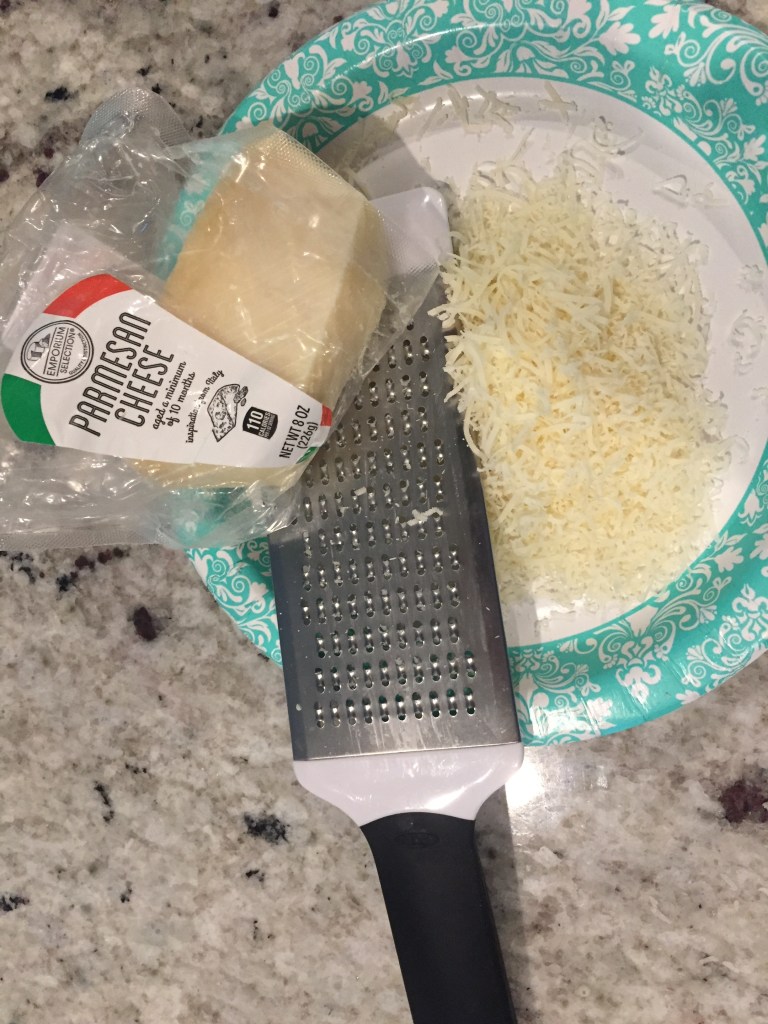
• Parmesan cheese. Grated cheese from a hard chunk will work much better than the kind you shake from a can. The cheese will aid in browning and provide a delightfully crispy and flavorful coating to the finished product.
• Butter
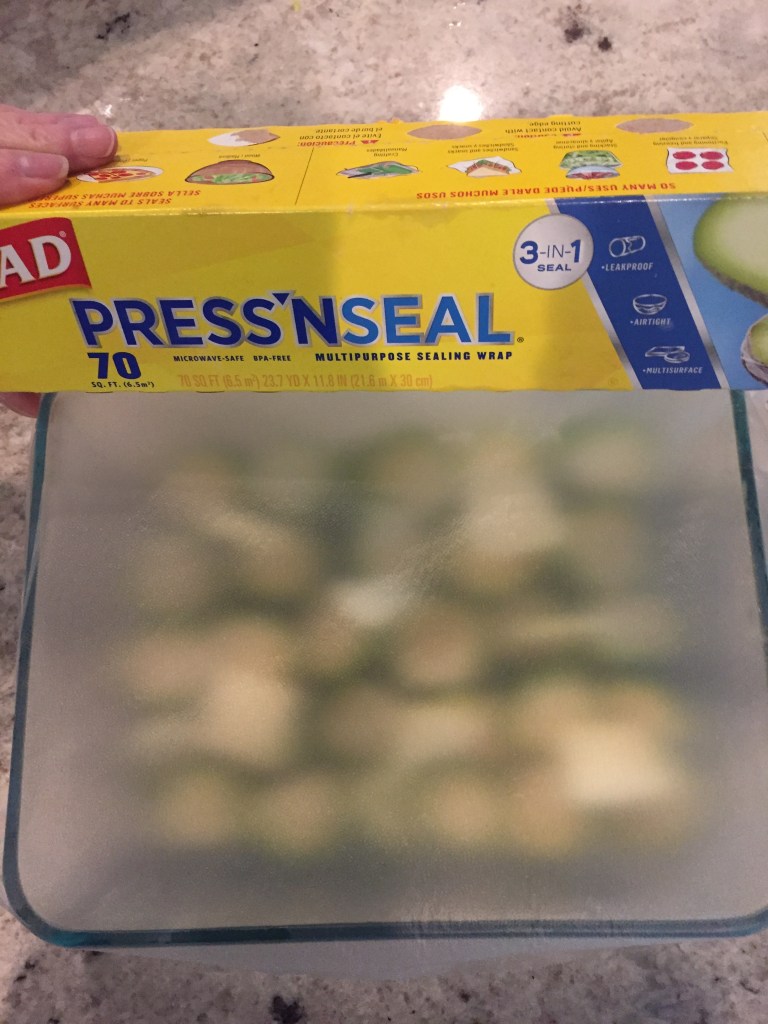
• Press ’N Seal multi-purpose sealing wrap. This stuff is heavier than that aggravating cling wrap, which you should not use for this project.
Here’s how to make the dish:
Go ahead and set your oven to 350 and start it preheating.
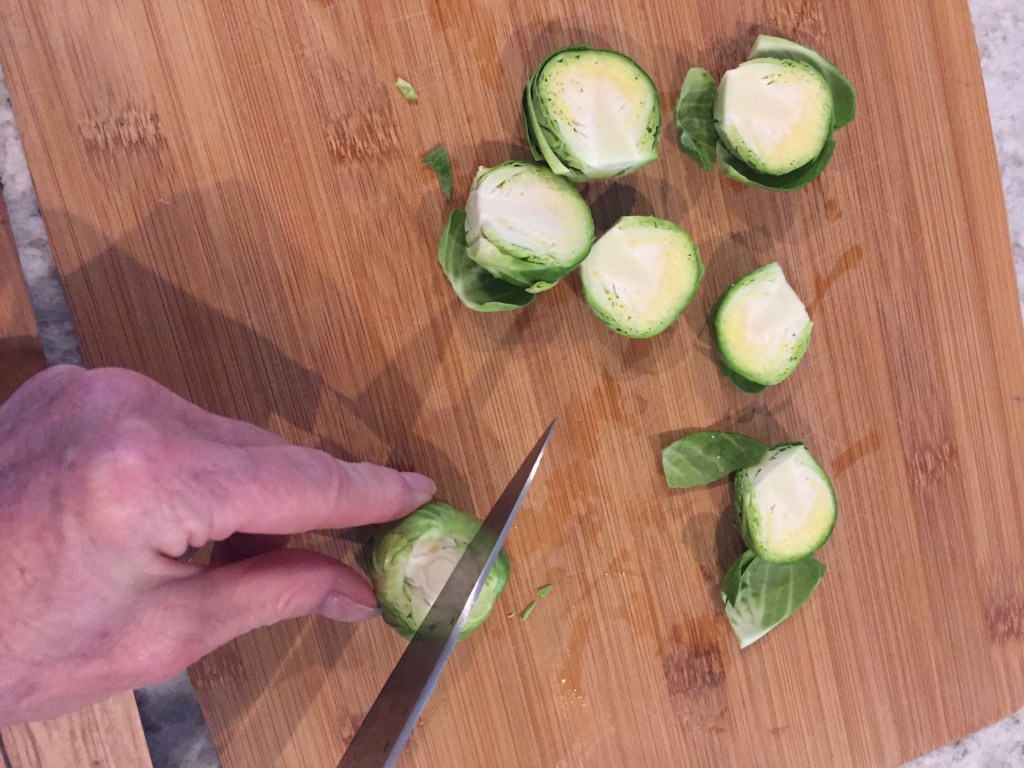
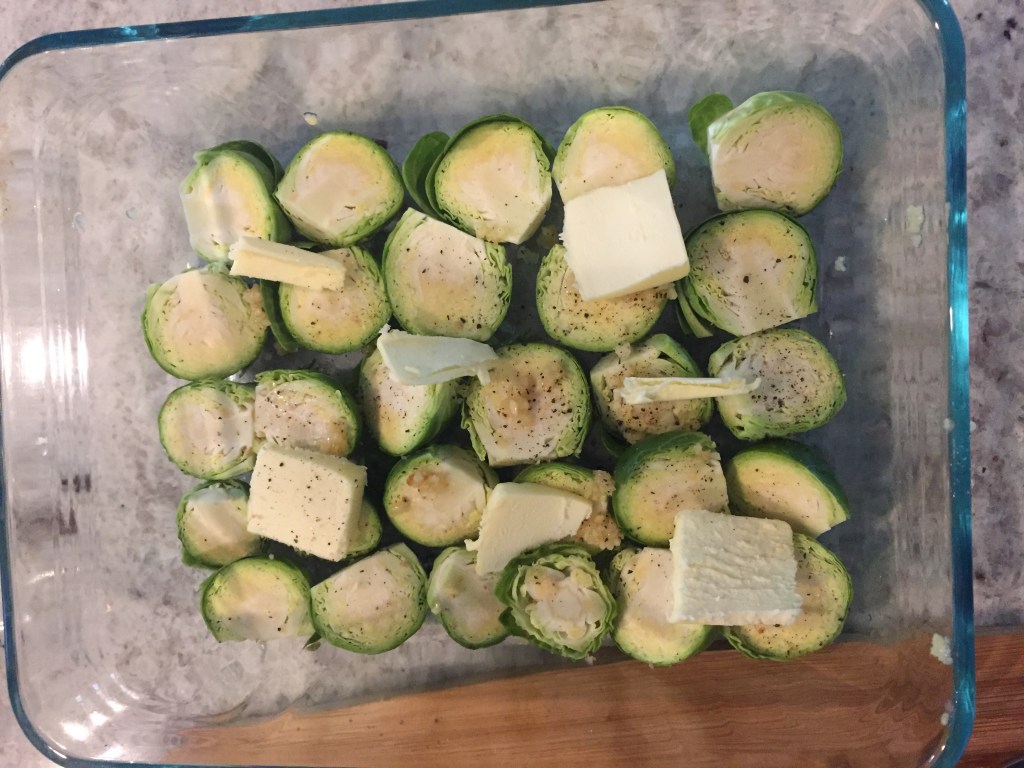
After finding a suitable dish, grab a good slicing knife and a cutting board. After rinsing the sprouts, cut off the stems and slice each one in half, long ways. Place the halves in the baking dish, cut side up.
Thanks to Carol O’Gorman Yates for her excellent work as hand model.
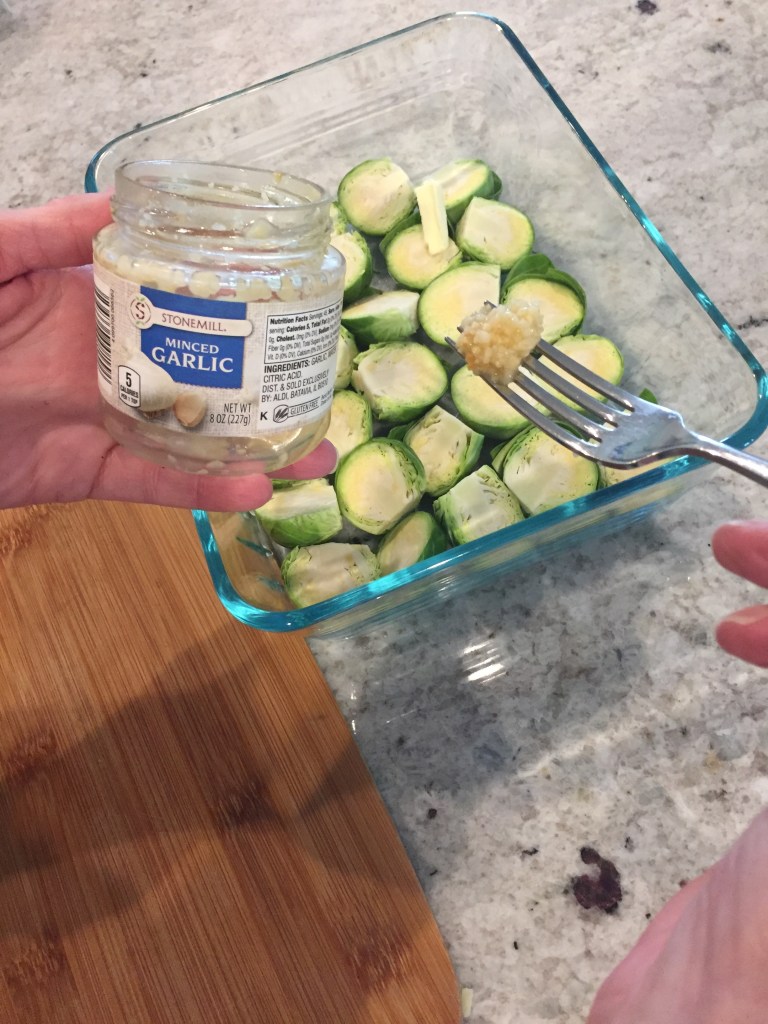
Spread the garlic as evenly as possible over and around the sliced sprouts. Add salt and pepper. Spread some thin pats of butter around in there. You can see in the picture how much we used for this dish. A little more or a little less won’t make much difference.
Carol and I find this minced, refrigerated garlic convenient, but you can use whichever type you choose. Butter pats with liberal amounts of salt, pepper, and garlic.
Sprinkle a little water over and around the sprouts. I simply wet my hand under the faucet and fling water with my fingers into the dish, repeating the process three or four times. I’m guessing this would amount to a couple of tablespoons. You won’t need much.
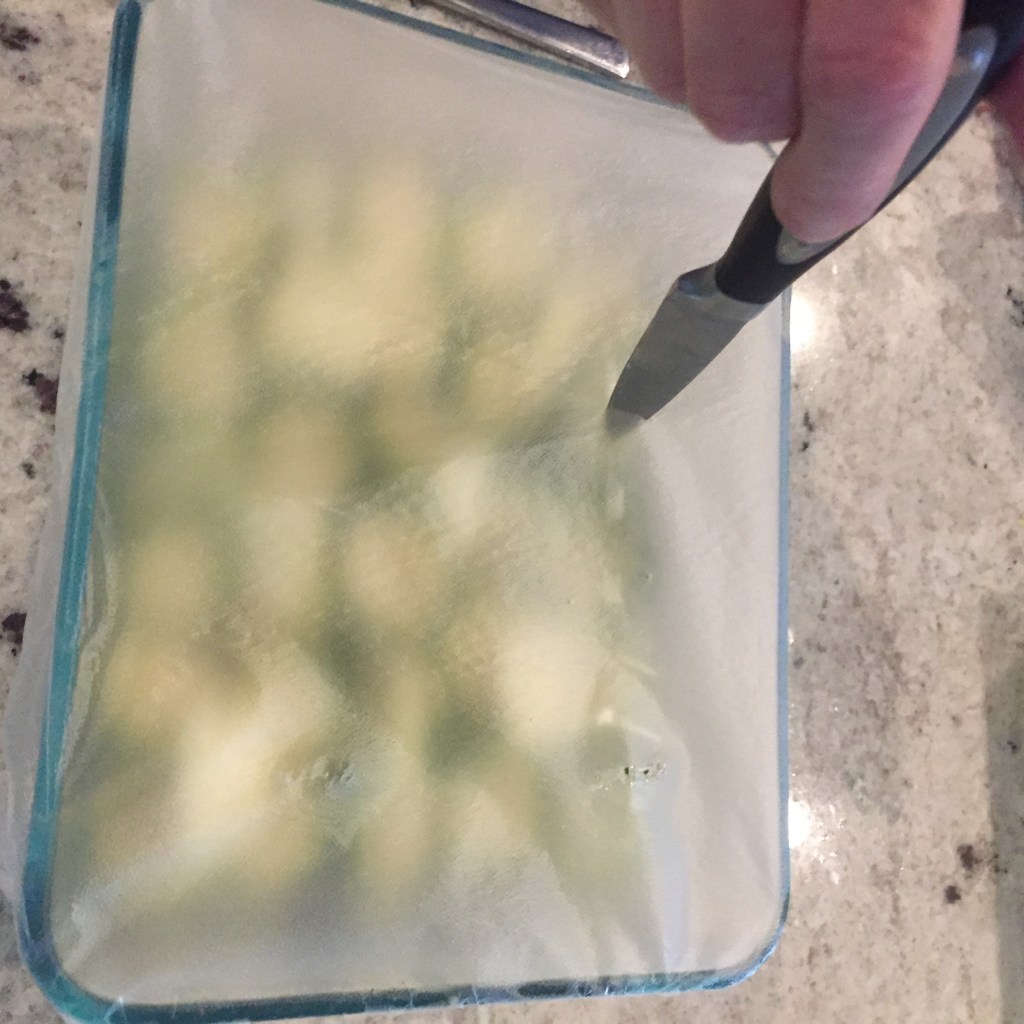
Now it’s time to cover and seal the dish with the sealing wrap. After getting it firmly in place, punch six or eight small holes through the wrap with a sharp knife. Don’t forget to do this!
This stuff is durable enough to withstand the heat it will soon be subjected to. Don’t use flimsy cling wrap!Punch some holes to allow a slow release of steam and to avoid a small explosion.
This next part may seem complicated but it’s really very forgiving, so don’t stress over it. You’re basically going to cook the sprouts in a series of short microwave bursts. This will get the centers hot and release some of the bad flavors as steam. The steam is partially trapped inside the dish, thanks to the Press ’N Seal. Each little timed burst makes more steam, which is then allowed to slowly escape, tenderizing the sprouts while you work on something else. Every minute or so return to the microwave and push the button again. Here’s the suggested sequence: Give it one minute at full power. Let the dish rest for maybe a minute. Hit the “add 30 seconds” button. Let the dish rest for half a minute or so. Hit the one minute button again. Work on something else for a minute or so before hitting the add 30 button again . . . and so on. Try to keep up with how many times you hit the buttons. Three one-minute bursts alternating with three 30 second bursts will be enough. Remember to allow time between so that the steam can do its work. Easy, right?
After that last 30 second zap, allow the sprouts to rest in their steam bath while you grate the parmesan, if you haven’t already done so. Three-fourths cup to a full cup is about right for a dish of this size. After the steam and heat have dissipated a bit, peel off the sealing wrap. Smells good in there, doesn’t it! After bathing your face in the aromas for a few moments, try piercing one of the sprouts with a toothpick to gauge its softness. This info will be valuable later. Next, sprinkle the grated cheese over the fragrant sprouts. You’ll want to pretty much cover the tops (cut sides) of the sprouts with the parmesan. Now place your dish into the hot oven.
Cover the fragrant steamed sprouts with grated parmesan.
Let them bake for about five minutes (before turning on the broiler) if you’d like them thoroughly cooked, depending on how soft they felt when you stuck the toothpick in. If they came out of the microwave fairly soft, go ahead and start the broiler on the high setting. Once it comes on, you’ll have only a few minutes to piddle around, cleaning up your mess or whatever. Keep your sniffer on high alert for the first signs (or smells) of burning. And look inside frequently. Pull them out when they look like the ones in the picture, golden brown!
Soft but not mushy, flavorful and crispy!
That’s it. Plate your meal and enjoy. Your perfect Brussels sprouts will make a fine complementary dish for almost any entrée, be it steak, pork, chicken, tacos, pot pies, pasta, or pizza! Let me know how it turns out.
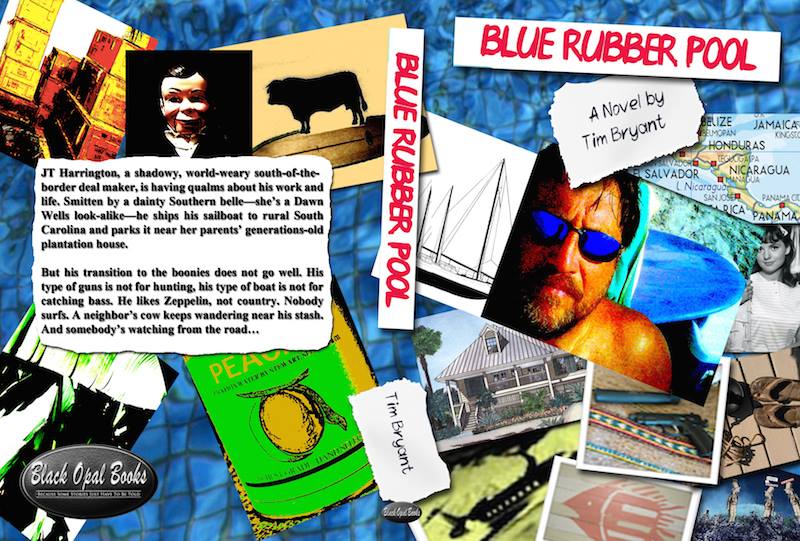
JT Harrington, the protagonist of Tim Bryant’s offbeat novel Blue Rubber Pool, is world weary but not particularly wise. He is, though, savvy about survival on the “Money Trail,” the seedy south-of-the-border domain of gun runners, drug dealers, money launderers, hit men, government–sponsored mercenaries, and prostitutes.
Through a plot that spirals in and out of a variety of locales, we encounter a wide-ranging cast of characters—most of them sleazy, unhinged, or both—who are at ease “letting their demons run free.” The versatile mind behind this wickedly twisted roller coaster ride turns out metaphors as effortlessly as a seasoned grill cook flips eggs. One can’t help but suspect that our multi-faceted protagonist is an extension of his creator or perhaps an alter ego.
JT has recently married Marianne, a Southern belle from rural South Carolina, but the lifestyle she represents is a sharp departure from the one he’s lived for years on the Money Trail. Indeed, he and Marianne are “opposites balanced on the fulcrum of time and place.” The tension between these two, their pasts and their divergent lifestyles, is what keeps the novel from ripping apart at the seams.
When they meet, Marianne is vacationing on a small island off Hilton Head. JT, having been at sea for a while, has briefly docked, readying for re-launch and a return to risky business in and around Honduras. He is salty, sweaty, and grease smeared from boat maintenance; she is prim, pretty, and innocent in a white sun dress. Her nails are painted, and as she politely nibbles a sandwich with pinky extended, JT’s eyes find “Goodness where before they were lost in Evil.” He watches spellbound as she expertly shucks oysters between delicate sandwich bites. Smitten by her proficiency with the shucking knife, he falls in love, fancying himself her protector, and follows her to her landlocked home in rural Jonesville.
JT’s love of sailing and beaches inspires him to tow his forty-foot ketch to the cow pasture adjacent to Marianne’s family farm where he plans to build a new life, securing the boat on jacks and living in it until his new dwelling—a beach house on stilts—is completed. He hopes Marianne will find it cozy, that it will be their little love nest, but she prefers the comfort of her parents’ big house. His new life becomes fraught with other frustrations: intruding cows, obnoxious turkeys, snakes, an overabundance of country radio stations, the unease of Marianne’s family and neighbors over his pretentious arrival, rednecks, and general boredom.
He develops a coping mechanism that includes floating in a blue rubber swimming pool picked up at the local Big Lots, booze, full-auto target practice with a duct-taped Uzi, Led Zeppelin, and weed. It doesn’t take long for him to realize he’s losing his edge. Soon, without even trying (or trying not to), he finds himself back on the Money Trail.
His life has become a tug-of-war between opposing desires. On one hand there’s comfort and safety in a pastoral setting with a beautiful woman who is “part rose petal on a church pew, part Hemi-powered oyster eater”; the competing impulse is toward the rush of adrenalin that rises out of being in the middle of—facilitating, even—major deals, minor uprisings, and military coups while sailing between Caribbean islands and sea ports or trekking through Central American jungles infested with deadly beasts and humans. One lifestyle provides peace and health, the other excitement and big paydays.
Built upon this see-saw, the narrative comprises an assortment of bizarre situations, flashbacks, and plot twists that illustrate the concept of being caught between two extremes. JT Harrington is—miraculously, after the hard knocks he experiences all along the money trail—a living, breathing, dazed-and-confused enigma seeking resolution. He discovers, though, that reconciling his past with the present and finding an inhabitable space between requires perhaps more fortitude, cleverness, and courage than he can muster.
One thing’s for sure, though: on the money trail it’s hard to tell the good guys from the bad. This never mattered much for JT before Marianne. Now, looking through a different colored lens, he’s presented with new possibilities, but in order to reinvent himself, he must conquer old habits and disentangle himself from former connections that are as twisting and binding as the kudzu surrounding his cow pasture. We eagerly join JT on his adventures to discover whether or not he is up to the task.
Our compulsion continues as we delight in the intrigue, liveliness of language, colorful characters, dark humor, and harrowing action. For the thrill-seeker residing in all of us, Blue Rubber Pool provides the giddy catharsis of a twisting, plunging ride on the amusement park’s most unique roller coaster. Board at your own risk. Once the ride starts, you won’t be able to get off.
Tim Bryant agreed to answer a few questions regarding his background, style, influences, process, and life in general. What follows will provide insight for anyone interested in novel writing and how life experiences affect the creative process:
RY: The narrator of your novel displays a love of the sea and sailing. The details indicate that you may also have these proclivities. Do you currently own a boat? What are the most enjoyable aspects of sailing? Feel free to share some of your sailing adventures.
TB: Sailing kept my soul from hardening regardless of hard times and hard people around me. I started as a grade-schooler. Heading out alone with nobody stipulating a direction or timetable made the world open up a zillion times its size—bringing a sense of freedom to an otherwise very claustrophobic childhood. As the boats got bigger, the lakes became oceans and more and more things of nature were revealed to me: its currents and tides, its fishes and animals, its changing moods of weather—things I might have missed otherwise. At the same time, I became aware of sailing as a transactional intersection of wind, water, and Man. I became more in touch with our ancient great-greats—the first who went out beyond sight of land and yet looked up at the same stars and moon as me. Although I’m presently boatless for several reasons including a bad injury, I see waves every time a breeze stirs the field grass at Pineapple Hill, my beach house in a cow pasture in rural South Carolina.
RY: You seem to know a great deal about espionage and intrigue—government sponsored and otherwise—in Central America. Is this knowledge based on experience, thorough research, or a combination?
TB: I was asked this in a writers’ circle once. I froze up for a second until a Dali across the room caught my eye. “It’s the same as that,” I replied, pointing to the framed print. “How much of that is real?” There’s an awful lot of truth in Blue Rubber Pool yet not an ounce of stolen valor. It was written as a love story. A not-so-righteous guy meets an über Godly girl. Tranquility conflicts with chaos. Trust sumo wrestles skepticism. Baggage aches to be jettisoned to enable pursuit of that genuine soul mate. When it was written, I was living in a lava lamp situation, a kaleidoscopic mid-life melt down combining PTSD with a long lost bag of weed and Led Zeppelin cassette, clients across several area codes, some with Uzi-carrying bodyguards, some requiring I own guns too. I was miles from open water— feeling claustrophobic again. My purchase of that kiddie pool was either a symbolic return to the serenity of the womb or last ditch attempted baptism. I rode that pool float every day for most of a summer—writing in the mornings about trying to save myself in the afternoons.
RY: Is becoming a novelist a recently acquired aspiration or a long-harbored one? Who or what was responsible for starting you along this path? Do you have advice for others interested in taking up this pursuit?
TB: I discovered writing for fun—I’ve always called it “recreational” writing—approximately the same time I started sailing. Writing brought sailing’s same sensations of freedom, hope, and adventure. Nobody controlled my thoughts or the enjoyment of exploring them. I could create new worlds all my own in poems or short stories. My English teachers encouraged me while math teachers punished me with Fs. It was a good cop, bad cop thing that pushed me into a habit of writing a bit here and there no matter where I was in my experience of being alive. Initially this was done late at night but eventually it became a very early-in-the-day thing in which I wouldn’t punch my time card until clearing my head of what ever needed out and onto paper. Now, living on a small farm with just a puny vineyard and a few peach trees to tend to, I’m able to give it a more serious go. I’m committed to publishing at least five novels. It has to be that many. After that, maybe I’ll buy a motorcycle. As for advice to other writers starting out, the best thing I ever heard was simply “to be a writer, one must write!” Tinker with it as much as you can and wherever it leads in search of your truest writing voice. Do it for your own satisfaction and if you get a bad critique don’t fold up like a dying spider.
RY: The protagonist of Blue Rubber Pool, JT Harrington, is a risk-taking adventurer, complex and slightly unhinged. How are JT and Tim Bryant similar? Different? Are any of JT’s traits based on other characters either real or fictional?
TB: Well, in the sense that Blue Rubber Pool is a blurred memoir, JT and I are pretty much the same guy blurred into one. We both have love/hate relationships with the world around us. We’ve both moved a lot yet never felt at home. We’re both tired of looking over our shoulders or way up ahead, on guard for the next sucker punch. Same as JT, I want peace and quiet now. Clarity between good and evil. A better sense of how God and faith figure into all that. No wonder JT and I both seem unhinged, we’re in a desperate state of spiritual overhaul. JT and I are both like an armadillo—rolling up into a protective ball to protect what’s inside, spirits seeking grace. This is explored in my other manuscripts too. I’m in a very intense phase of life. George Harrison’s My Sweet Lord or Al Green’s Take Me to the River are my sound track now and they play on continuous loop. That’s great. But there’s also paranoia and distrust at play. It’s a hit-the-brakes-while-also-hitting-the-gas situation of believing there is a reason for the universe but not trusting Man to explain it.
RY: Please name a book or two that made lasting impressions on you as an author? Can you think of certain titles that would be generally beneficial for aspiring writers?
TB: In my teens and early twenties, I discovered John Irving’s easy going writing voice and ability to conjure up oddball situations bordering on the absurd. I also liked Jack Kerouac for his improvisational writing style. Whatever stream of consciousness he laid on the page stayed on the page without losing its honesty through rounds of revision. I liked James Michener’s willingness to take his own sweet time getting a story going—sometimes starting at the Beginning of All Beginnings: a tiny shrimp-like life form washes ashore then through a gazillion years evolves into humans. I liked Hunter S. Thompson’s cynicism, Charles Bukowski’s rugged reality, and how Williams Carlos Williams, a busy doctor, took snapshots in skinny snippets that would fit on his tiny prescription pad. Of course, Pat Conroy will always be a favorite—not only as a Southern voice but for stories as hard as they are soft. I’m probably still into writing because these and other authors gave me a satisfying place to start. Musicians and painters get hooked the same way. Blues led to rock. Politics led to abstract expressionism in the visual arts. We are all the sum result of our experiences. It would be dishonest to ignore them.
RY: Describe your methods for making a novel. Do you plot heavily with outlines, diagrams, and note cards; or do you simply give your characters free rein, allowing the narrative to develop organically? Please describe any hybrid or unique techniques that you employ.
TB: There’s a thumb drive at Pineapple Hill with four novel-length manuscripts stored on it and there’s a box in a closet with other bits and pieces of a fifth. None of these began with a goal of going hundreds of pages long. They evolved from an hour or so of jotting down whatever came to mind, perhaps a vague sensation snagged out of the air, the spark of a memory or even a long ago dream, a déjà vu that stayed on then wanted out. If it seemed interesting enough, I’d pick it up the next day and the next until, after five to ten pages, if I still had interest, I’d take a break to consider a possible path for the long haul. Usually, this involved roughing out a brief synopsis—no more than a few paragraphs—and then a few ideas—just bullets—about the characters. For instance, what they look like, what motivates them, and what their role might be. Then I jump back in to see if it feels right. If it does, I stop again to graph the story arc and create a mind chart showing key variables. Ready-made templates handed out by grade school teachers are good for this—I like their simplicity. Then I dive back in, periodically assessing my progress and correcting course as needed. Because I have no formal training, I had to learn the hard way that planning helps capture opportunities for a better story while saving on revisions later. That said, I keep planning at a minimum. One writer I know has spent literally years mapping out her novel. She gets no joy from just writing for the fun of it.
RY: What about your current projects? What sort of fictional gems might your readers expect from you in the future?
TB: Well, as mentioned, there’s four manuscripts on a thumb drive and bits of another in a box.
Of these, Blue Rubber Pool, is published with enough bits left over to get a sequel going later. It’s one of four connected stories. Not a series per se. More like a collection. As if the same soul quantum-leaped into different men in different mid-life implosions, each face-planting into his own fears and regrets same as I did that summer.
Birdwatching on Edisto, for instance, is about an Atlanta advertising executive who divorces, loses his job, and must move back in with his elderly mother on the South Carolina sea island where he was born and raised. It’s a fun story about familial responsibility, Southern traditions, and island life. I’ve turned down two contracts on it recently because I’m new to this and there’s a lot of scams going.
Also set in the Charleston area is The Stained Glass Mustang about a sales and marketing guy who drives drunk, kills a kid, and loses everything (job, wife, home, friends, etc.). He lives alone at a crappy marina. His only client is a dishonest, belligerent con man. He’s close to getting fired until his estranged father leaves him a muscle car painted up with images from Christianity. It’s a bit dark and full of symbolism. Great fun to write. This one had a publishing contract too but the pandemic screwed it up.
The one I’m working on now, Old Hotel by the Sea, is about a mailbox salesman—he specializes in the type used at apartment complexes and business parks—who accidently kills his fifth wife during their honeymoon. He plans to commit suicide at the place where he met wife number one but things keep getting in the way. Not as dark as it sounds. Lots of moving parts built in. A great project for this winter. I’m halfway through the second draft.
As you can see, I evidently can’t say enough about my mid-life crash and burn. I enjoy messing with it as a cat messes with a cockroach. The world is so simple and yet also ridiculously complex. That’s the God in it, I believe, and all around us saints are like shepherds. Established saints but also new ones, unknown—saints in the making—at war with evil behind the scenes, cleaning up the sins we leave like footprints. Large and small.



 Ron Yates, Author